
The core objective of this project is to replace the adsorption system in the dimerization unit feed dryers. The process imposes stringent drying requirements on the propane–propylene fraction (PPF) feedstock—outlet water content must be reduced to trace levels, and pressure drop must remain within acceptable limits throughout the entire service life. These requirements stem from a critical risk: moisture is a severe poison for the dimerization catalyst and must be completely removed before the feedstock enters the reactor.
To achieve this objective, the system employs a combination of three functional material layers, each serving a distinct and essential role.
Layer 1: Activated Alumina (3–5 mm) – Pre-drying and Buffer Protection
Activated alumina is placed upstream of the molecular sieve bed. Its role is not deep dehydration, but pre-drying and buffer protection.
Activated alumina features a well-developed pore structure, high specific surface area, and surface active sites (hydroxyl groups and Al–O– groups). It can rapidly adsorb water molecules through physical adsorption (van der Waals forces). Its advantages lie in fast adsorption kinetics and relatively low regeneration temperatures, enabling it to remove free water from the PPF feedstock during each adsorption cycle.
More importantly, the presence of activated alumina buffers the adsorption load on the molecular sieve bed. If the entire dehydration task were imposed solely on the molecular sieve, its regeneration frequency would increase significantly and its service life would be shortened. By sharing the removal of free water, activated alumina allows the molecular sieve to focus on removing dissolved water – the more challenging task – thereby optimizing the overall system performance and longevity.
Layer 2: 3A Molecular Sieve – Selective Deep Dehydration
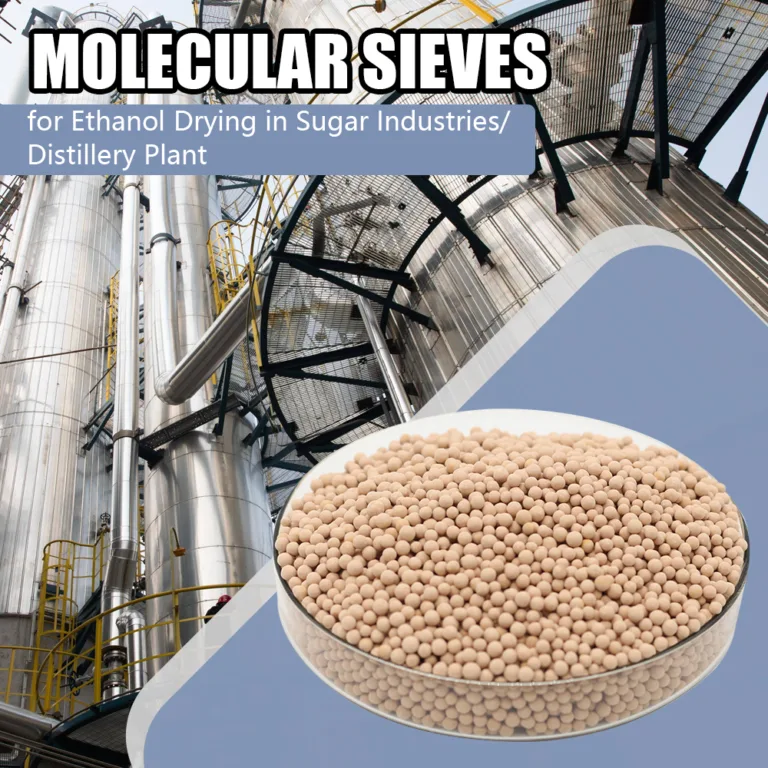
The 3A molecular sieve is the core of the system. Its effective pore aperture is approximately 3 Å (0.3 nm), which allows water molecules (kinetic diameter ~2.8 Å) to enter the pores while effectively excluding the vast majority of hydrocarbon molecules – including propylene, propane, and others (kinetic diameters > 3.6 Å).
The project requires outlet water content to be reduced to trace levels, which qualifies as deep drying. Only molecular sieves can reduce the dew point of liquids or gases to extremely low levels. While activated alumina adsorbs quickly, its equilibrium adsorption capacity at low water vapor partial pressures is far inferior to that of molecular sieves, making it incapable of meeting this standard on its own.
Furthermore, the 3A molecular sieve is supplied in spherical form, offering good flowability, uniform packing, and high mechanical strength. It maintains structural stability under cyclic operating conditions involving liquid-phase adsorption and gas-phase thermal regeneration, generating minimal dust and effectively controlling pressure drop growth.
Layer 3: 23%–26% Inert Ceramic Balls – Mechanical Support and Flow Distribution
The inert ceramic balls (Al₂O₃ content 23%–26%) are not adsorbents – their task is support and protection. They are placed at the bottom and top of the bed, serving the following critical functions:
Supporting the bed: Carrying the weight of the overlying molecular sieve and activated alumina layers to prevent collapse or displacement.
Uniform flow distribution: Ensuring that the incoming PPF is evenly distributed across the bed cross-section, preventing channeling and ensuring effective utilization of all adsorbent material.
Shock absorption: During adsorption/regeneration switching, the system undergoes rapid pressure fluctuations. The ceramic balls buffer the mechanical impact on the adsorbent bed, protecting the molecular sieve and activated alumina from being scoured or worn by the gas/liquid flow.
The project mandates a low pressure drop across the adsorber. The ceramic balls have high void fraction and low pressure drop contribution, so their presence as a support layer imposes negligible additional pressure drop on the system.
The synergy among the three materials achieves a balanced performance across four dimensions: adsorption selectivity, dehydration depth, bed pressure drop, and operational service life. Activated alumina handles bulk water removal; the molecular sieve delivers polishing dehydration; and the ceramic balls provide a stable mechanical framework for the entire process.
This design is specifically tailored to meet the challenging target of reducing inlet water content from high levels to trace levels at the outlet – a requirement that demands precision engineering at every layer.
For more information about XINTAO’s adsorbent solutions for petrochemical applications, please visit www.xintaokeji.com or contact us at info@xintaokeji.com.